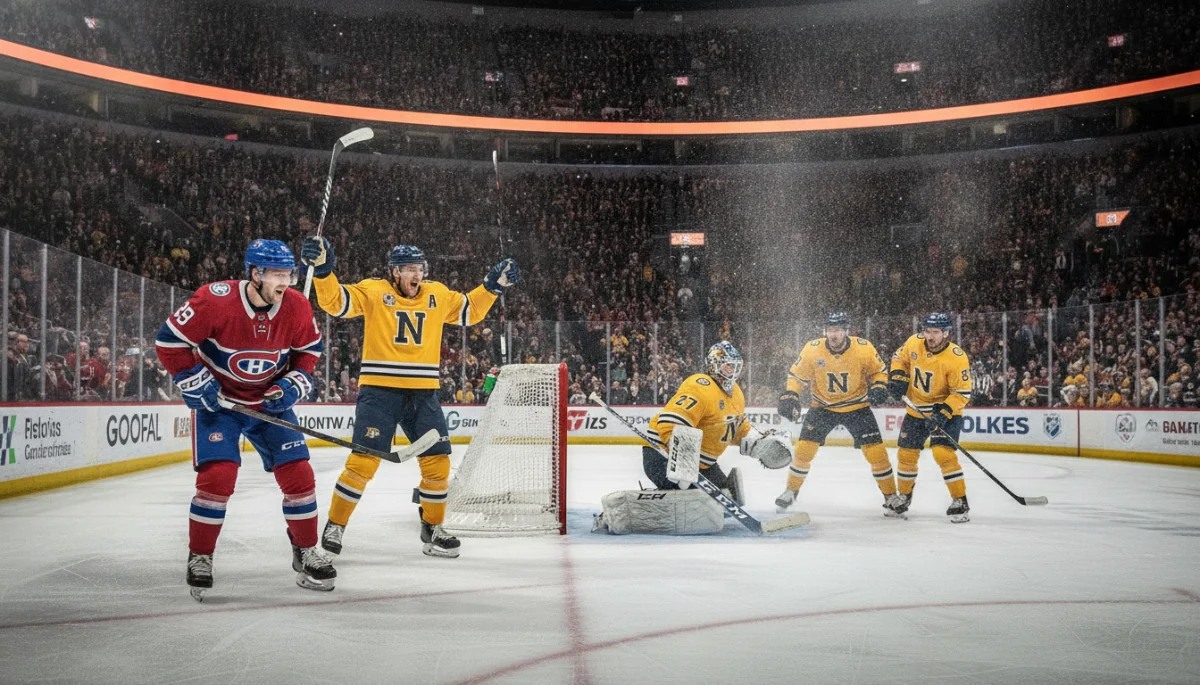
Montreal’s 5-2 loss to Nashville was not a simple case of the better team losing from start to finish. The Canadiens built a two-goal advantage, controlled much of the early action and outshot the Predators 34-18, yet they left Bell Centre without a point. Nashville responded with five consecutive goals, including two empty-net scores that made the final margin look more decisive than the game itself.
The defeat extended Montreal’s winless run to three games and left the Canadiens at 1-2-1. More troubling than the record was the way the game unraveled: missed chances kept Nashville alive, late penalties changed the special-teams battle, and two goals near the end of the second period erased Montreal’s momentum.
A Promising Start Lost Its Reward
Montreal established the tone before the scoreboard reflected it. The Canadiens spent long shifts in Nashville’s zone, moved the puck with purpose and forced Juuse Saros to handle repeated threats around the crease. That pressure eventually produced a 2-0 lead, but it never became the cushion Montreal needed.
Nick Suzuki opened the scoring during four-on-four play. The captain located a loose puck near the Nashville net and finished the sequence for his third goal of the season. Alex Newhook then doubled the advantage at 8:50 of the second period, completing Josh Anderson’s setup after another extended Montreal possession.
At that stage, the Canadiens appeared to have the game under control. Nashville was not generating much at five-on-five, while Montreal was winning territorial battles and creating the more dangerous looks. The central mistake was failing to add a third goal before the Predators found a way back.
A two-goal lead can disappear quickly in the NHL, particularly when the opposing goaltender is playing at a high level. Montreal’s inability to convert its strongest stretches gave Saros the chance to keep Nashville within reach.
| Key category | Montreal | Nashville |
|---|---|---|
| Final score | 2 goals | 5 goals |
| Shots on goal | 34 | 18 |
| Goaltender saves | Jacob Fowler: 15 | Juuse Saros: 32 |
| Power-play impact | Could not match Nashville’s production | Scored the tying and go-ahead goals |
| Empty-net scoring | None | Adam Edstrom scored twice |
Three Sequences That Changed the Night
- Montreal left the door open. Saros stopped 32 of the 34 shots he faced and repeatedly denied the Canadiens when they threatened to build a commanding lead. His performance mattered because Nashville did not need to create a large number of chances while its goaltender continued to protect a one-goal game.
- Kerfoot and Wood restored Nashville’s belief. Alexander Kerfoot cut the deficit to 2-1 with 4:54 left in the second period by redirecting Adam Wilsby’s point shot. Only 32 seconds before intermission, Matthew Wood tied the game on the power play. Montreal went from holding a two-goal edge to entering the third period even with a revived opponent.
- Anderson’s breakaway went unfinished. With roughly eight minutes remaining in regulation, Josh Anderson moved in alone against Saros. A goal would have put Montreal back ahead 3-2, but Saros made the crucial left-pad save. Nashville stayed level, and the Predators later received the power play that produced the deciding goal.
Those moments show why the result was so frustrating for Montreal. The Canadiens generated enough offense to win, but their best opportunities either ended with a save or never became shots on goal. Nashville, by contrast, made its limited openings count.
Special Teams Turned Pressure Into a Defeat
The game’s decisive advantage belonged to Nashville’s power play. Wood’s tying goal arrived with the man advantage late in the second period, and Ryan O’Reilly later scored the go-ahead goal on another power play with 3:16 remaining.
Mike Matheson’s tripping penalty against Steven Stamkos created the opening for Nashville’s winner. Roman Josi sent the puck toward the net, and O’Reilly redirected it past Jacob Fowler to give the Predators their first lead of the night.
For Montreal, the issue was not simply taking penalties. The timing made each infraction more damaging. The Canadiens had already watched Nashville gain momentum from its first power-play goal, then handed the Predators another opportunity in a tied third period.
Montreal also failed to answer with comparable special-teams production. When five-on-five play is close and an opposing goaltender is stopping nearly everything, the power play must supply a timely response. Nashville did that twice; Montreal did not.
Fowler Was Not the Main Reason Montreal Lost
Jacob Fowler’s first start of the season came under difficult circumstances. The 21-year-old was recalled from Laval after Samuel Montembeault suffered a lower-body injury during Wednesday’s practice, then faced a Nashville team that became increasingly dangerous as the game progressed.
Fowler stopped 15 shots, and the raw final score does not fully describe his performance. Two of Nashville’s five goals came into an empty net after Montreal pulled its goaltender, meaning Fowler allowed three goals while actually defending the crease.
That does not mean every goal was unavoidable, but assigning the defeat primarily to Fowler would miss the larger story. Montreal’s forwards failed to extend the lead, the penalty kill surrendered the tying and winning goals, and the team could not protect its momentum after Anderson’s breakaway chance.
The injury to Montembeault nevertheless creates a significant question. Fowler gained experience last season by appearing in 17 games and posting a 9-6-2 record, a 2.43 goals-against average and a .908 save percentage. He has already shown that he can handle NHL action, but an extended absence for Montembeault would place meaningful responsibility on him much earlier than planned.
The Score Hides Montreal’s Competitive Performance
Adam Edstrom’s two empty-net goals transformed a one-goal game into a 5-2 result. That distinction matters when evaluating Montreal’s performance. The Canadiens were outplayed in the closing minutes, but they were not three goals worse throughout regulation.
For long stretches, Montreal controlled the puck and created more offensive pressure. The team’s breakdown was one of execution rather than complete territorial failure. A stronger finish around the net, cleaner discipline and one timely save at the other end could have produced an entirely different outcome.
That should provide some perspective without excusing the collapse. Teams that want to move forward cannot treat strong possession numbers as a substitute for finishing. Montreal had the advantage in shots but lost the portions of the game that decide close contests.
Suzuki Offers a Clear Positive
Suzuki’s goal continued a productive opening stretch for Montreal’s captain. He now has three goals early in the season, and his willingness to attack the area around the net provided the kind of direct offense the Canadiens needed more consistently.
Montreal will need Suzuki to remain heavily involved while injuries create uncertainty elsewhere in the lineup. His goal was not merely a positive individual moment; it demonstrated the type of assertive play that can turn possession into a tangible advantage.
What Must Change Against Detroit
The Canadiens return to Bell Centre on Saturday to face the Detroit Red Wings, giving them an immediate opportunity to correct the habits that cost them against Nashville.
First, Montreal must make its pressure more dangerous. Sustained zone time is useful only when it creates rebounds, screens and second opportunities. The Canadiens cannot repeatedly control play and settle for a lead that remains within one scoring chance.
Second, discipline must improve. Nashville’s tying and winning goals both came on the power play, and late penalties are especially damaging when the game is level. Montreal’s defenders need to manage their sticks and feet without giving opponents a chance to decide the outcome from the special-teams unit.
Third, the team must support its goaltender. Whether Fowler starts again or another option takes the crease, Montreal can reduce the pressure by limiting net-front traffic, clearing rebounds and preventing avoidable penalties.
The loss does not justify panic at 1-2-1, but it does expose a lesson Montreal cannot ignore. The Canadiens showed they could dictate play against Nashville; they did not show they could finish the job. Against Detroit, the response will be measured by whether the team turns control into goals, protects a lead and stays composed when the game becomes tight.