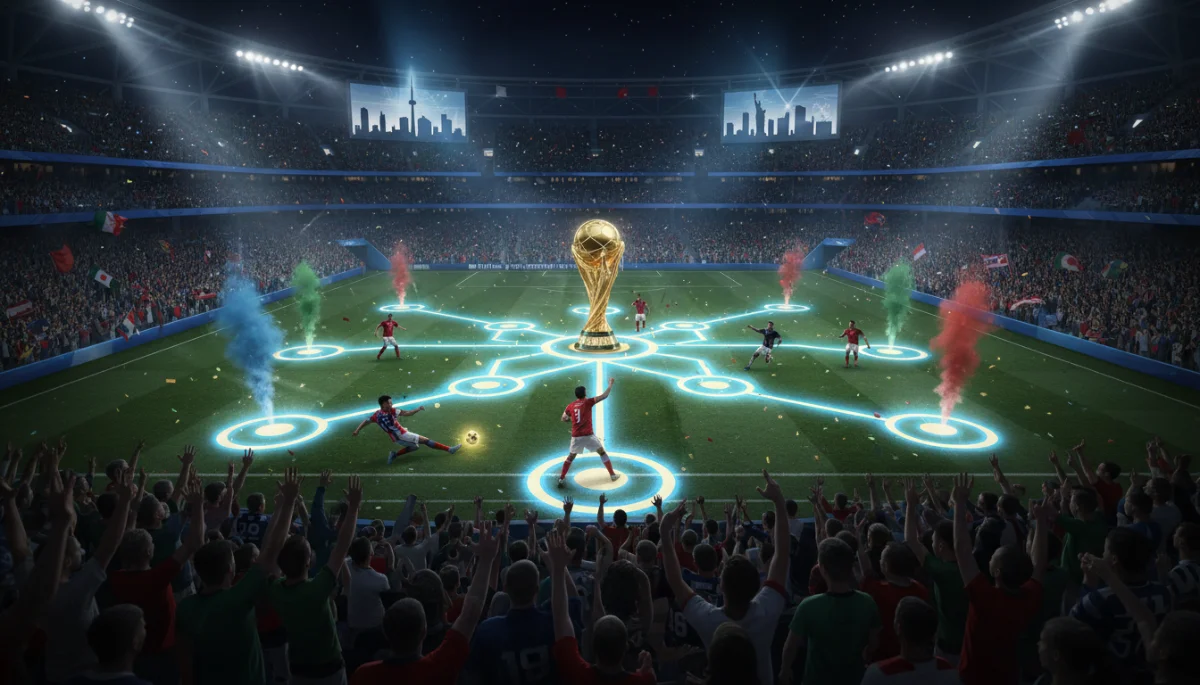
The 2026 tournament is built to be bigger than anything before it. With 48 teams, 12 groups, and a 32-team knockout phase, the path to the title is longer, busier, and more unpredictable. Matches will be spread across Canada, the United States, and Mexico, and the bracket will shape every team’s chances from the opening whistle to the final on July 19.
The new format in simple terms
The old 32-team World Cup is gone. In its place is a field of 48 nations divided into 12 groups of four. Each team plays three group-stage matches, and the bracket rewards both consistency and scoring power. The top two teams in every group move on automatically, while eight third-place teams also advance.
That creates a Round of 32 for the first time in World Cup history. It also means more teams stay alive longer, which gives the tournament a different rhythm from start to finish.
What changes most for fans
- More matches in the opening phase
- A larger knockout bracket
- More third-place scenarios to monitor
- Greater room for upsets and surprise runs
From group play to knockout pressure
The group stage runs from June 11 through June 27, with 72 matches deciding who moves on. Points come first, then goal difference, then goals scored. If teams are still level, head-to-head results, fair play points, and FIFA ranking come into play.
The eight best third-place finishers are placed into the knockout draw through a preset bracket matrix. That setup matters because the exact group combinations determine the road ahead. A team can finish third and still get a favorable matchup, or land on the tougher side of the bracket.
| Stage | Dates | What matters |
|---|---|---|
| Group stage | June 11 to June 27 | Top two plus eight best thirds advance |
| Round of 32 | June 28 to July 3 | First knockout round in World Cup history |
| Round of 16 | July 4 to July 7 | Pressure rises fast |
| Quarterfinals | July 9 to July 11 | Only eight teams remain |
| Semifinals | July 14 and July 15 | Title contenders separated from the rest |
| Third-place match | July 18 | Final chance for a podium finish |
| Final | July 19 | MetLife Stadium hosts the last match |
What the knockout bracket demands
Once the group stage ends, there are no second chances. Teams need five straight wins to lift the trophy, one more than in the old format. Every knockout match goes to extra time if needed, and penalties settle the tie if the score is still even after 120 minutes.
There are no replays and no away goals. It is direct, simple, and unforgiving.
Bracket progression at a glance
- Round of 32
- Round of 16
- Quarterfinals
- Semifinals
- Third-place match
- Final
Canada’s route through the tournament
Canada are placed in Group B with Bosnia and Herzegovina, Qatar, and Switzerland. Their opening match comes on June 12 at BMO Field in Toronto against Bosnia and Herzegovina. After that, they head to Vancouver’s BC Place for games against Qatar on June 18 and Switzerland on June 24.
A top-two finish sends Canada straight into the Round of 32. Even if they finish third, strong results could still be enough to advance. Their possible first knockout opponent could come from Group A or Group C, which adds another layer of uncertainty to the path.
Groups worth following closely
Some groups look especially dangerous because of the teams involved. Group C stands out early, with Brazil joined by Morocco, Haiti, and Scotland. Group D also draws attention because it features the United States, Paraguay, Australia, and Türkiye, all of whom have a realistic shot at advancing.
Elsewhere, Argentina, Spain, France, and England are spread across the draw, which raises the chance of major late-stage clashes if the favorites win their groups.
Why the bracket matters so much
The expanded structure changes more than the schedule. It affects travel, rest, matchups, and momentum. For supporters, it means more games to follow and more scenarios to track. For teams, it means every goal can matter, especially when third-place positions are decided by fine margins.
That is what makes the 2026 bracket so compelling: it rewards strong starts, punishes mistakes, and keeps the path to the final wide open until the last rounds.
The 2026 World Cup bracket is not just larger. It is more layered, more competitive, and far less predictable from the start.
For official tournament updates and bracket details, visit FIFA’s World Cup hub.