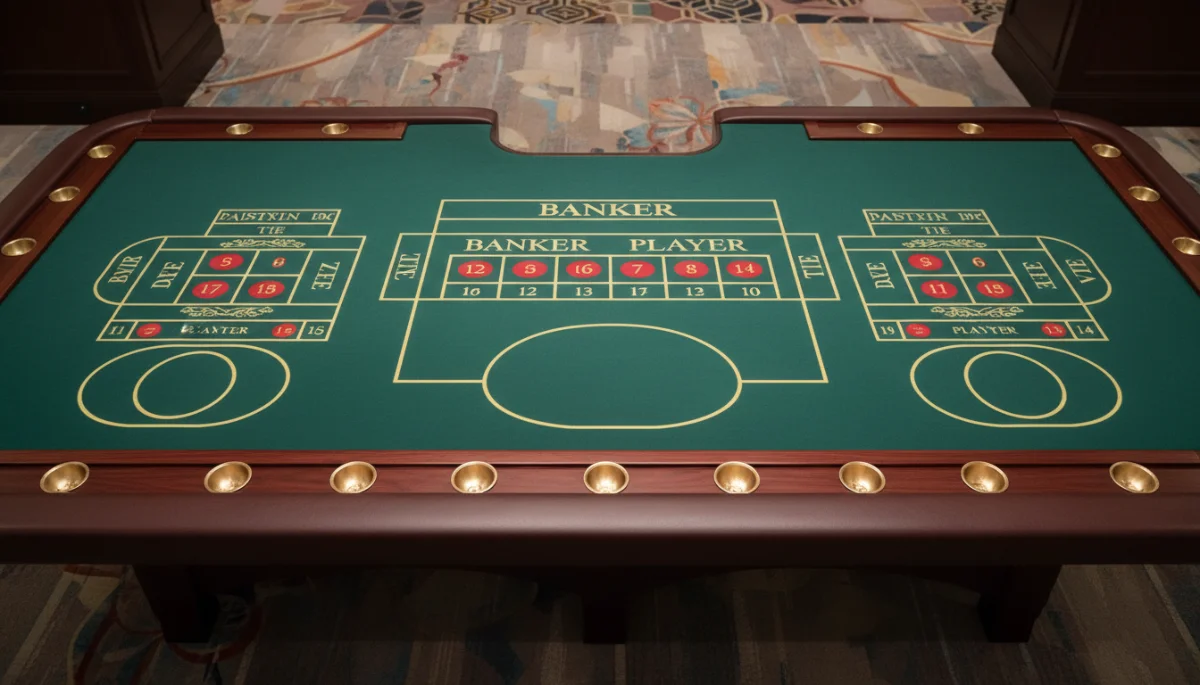
Baccarat captivates players with its allure of spotting trends in outcomes, yet mathematics reveals this pursuit as futile. Each hand remains independent, unaffected by prior results, debunking the persistent belief that scorecards predict future wins.
This detailed exploration examines the origins of pattern tracking in baccarat, the unyielding probabilities governing play, cognitive reasons for its appeal, flawed strategies reliant on it, and effective approaches grounded in facts. By understanding these elements, players gain a realistic perspective on the game.
Understanding Baccarat’s Tracking Tools and Their Appeal
In casinos worldwide, baccarat stands out for its elaborate result-tracking systems, designed to engage players deeply. Physical venues supply complimentary scorecards, while overhead electronic boards display histories in varied formats. Online live dealer games mirror this setup faithfully.
Key tracking methods include:
- Bead plate: A simple grid logging Banker, Player, and Tie outcomes in sequence, colour-coded for quick reference.
- Big road: Columns of red (Banker) and blue (Player) circles, building downward for streaks and sideways for changes, creating visual patterns.
- Big eye boy: Analyses big road consistency, marking repetitions or shifts with red or blue symbols.
- Small road: Similar to big eye boy but starts from the second entry in big road columns.
- Cockroach pig: Tracks from the third entry, highlighting further derivations.
These tools transform raw results into intricate visuals that seem prophetic. However, they merely chronicle past events, reformatted to emphasise repetitions or alternations. To novices, they appear as advanced analytics; to probabilists, they record randomness without foresight.
The shoe, typically six or eight decks, shuffles thoroughly before play. Removed cards alter the deck minimally per hand, with effects too negligible for practical prediction. Probabilities stay constant: approximately 45.86% for Banker, 44.62% for Player, and 9.52% for Tie, irrespective of history.
The Independence Principle and Gambler’s Fallacy
Central to debunking pattern myths is the independence of hands. Unlike dependent events such as drawing without replacement from a tiny deck, baccarat’s multi-deck shoe ensures each round’s outcome hinges solely on current draws, not precedents.
Consider a streak of ten Banker wins: it does not tilt odds toward Player next. The deck lacks memory; no cosmic force demands balance. This misconception embodies the gambler’s fallacy, where individuals expect reversion after extremes in random processes.
Studies in probability confirm random sequences feature clusters more frequently than perceived. For instance, in coin flips, six heads in succession occurs about once every 64 trials on average—normal, not anomalous. Baccarat mirrors this: streaks arise naturally, fooling pattern seekers.
Here’s a table comparing perceived versus actual randomness in baccarat outcomes:
| Scenario | Intuitive Expectation | Mathematical Reality |
|---|---|---|
| After 5 Bankers | Player “due” | Odds unchanged (45.86% Banker still) |
| Long shoe streak | Shoe will “correct” | No correction; independence holds |
| Alternating pattern | Continues reliably | Breaks randomly; no persistence |
| Tie after many non-Ties | Tie imminent | 9.52% probability always |
This table illustrates how human intuition clashes with statistics, perpetuating ineffective tactics.
Cognitive Roots of Pattern Obsession
Human brains excel at pattern recognition, a trait honed by evolution for survival. Detecting rustling grass as a threat or seasonal prey migrations proved vital; false positives cost little, while misses were fatal. Modern environments overload this system with random data like baccarat results.
Behavioural research, including works by Daniel Kahneman, shows people underestimate clustering in randomness. Players interpret five sequential Bankers as a signal rather than routine variance. Casinos exploit this by providing displays, boosting engagement without altering edges.
These aids encourage prolonged play and higher wagers, as belief in analysis fosters confidence. Displays accurately depict history but imply nonexistent predictability, sustaining the myth across generations.
Betting Systems That Rely on Illusions
Numerous strategies hinge on patterns, promising edges where none exist. Common examples include:
- Martingale: Double bets post-loss, assuming eventual wins recoup deficits. Ignores table limits and bankroll exhaustion amid house edge.
- Paroli: Double after wins, riding “streaks.” Captures variance temporarily but succumbs long-term.
- Trend following: Bet with apparent runs, chasing momentum.
- Trend reversal: Oppose streaks, anticipating flips.
All fail because they cannot override fixed odds. Progressive systems amplify variance, yielding short wins but inevitable losses over volume. With negative expectation (house edge), finite funds versus endless hands guarantee depletion.
For clarity, house edges on main bets are:
| Bet Type | House Edge | Payout |
|---|---|---|
| Banker | 1.06% (post-5% commission) | 0.95:1 |
| Player | 1.24% | 1:1 |
| Tie | 14.36% | 8:1 |
Tie and side bets worsen prospects, serving amusement over strategy.
True Strategy: Probabilities and Discipline
Dismissing patterns frees players for viable tactics. Prioritise Banker for its slim edge. Shun Tie despite allure. Manage bankroll rigorously:
- Set session limits upfront.
- Enforce stop-loss and win goals.
- Avoid chasing losses via escalation.
- View play as leisure with defined cost.
Baccarat’s elegance lies in simplicity: swift pace, minimal choices, sophisticated vibe. Free from mythical forecasts, enjoyment deepens through presence in the moment.
Shoes shuffle afresh; cards ignore history. Scorecards chronicle, not prophesy. Embracing this truth fosters responsible, fulfilling engagement with baccarat’s timeless appeal.