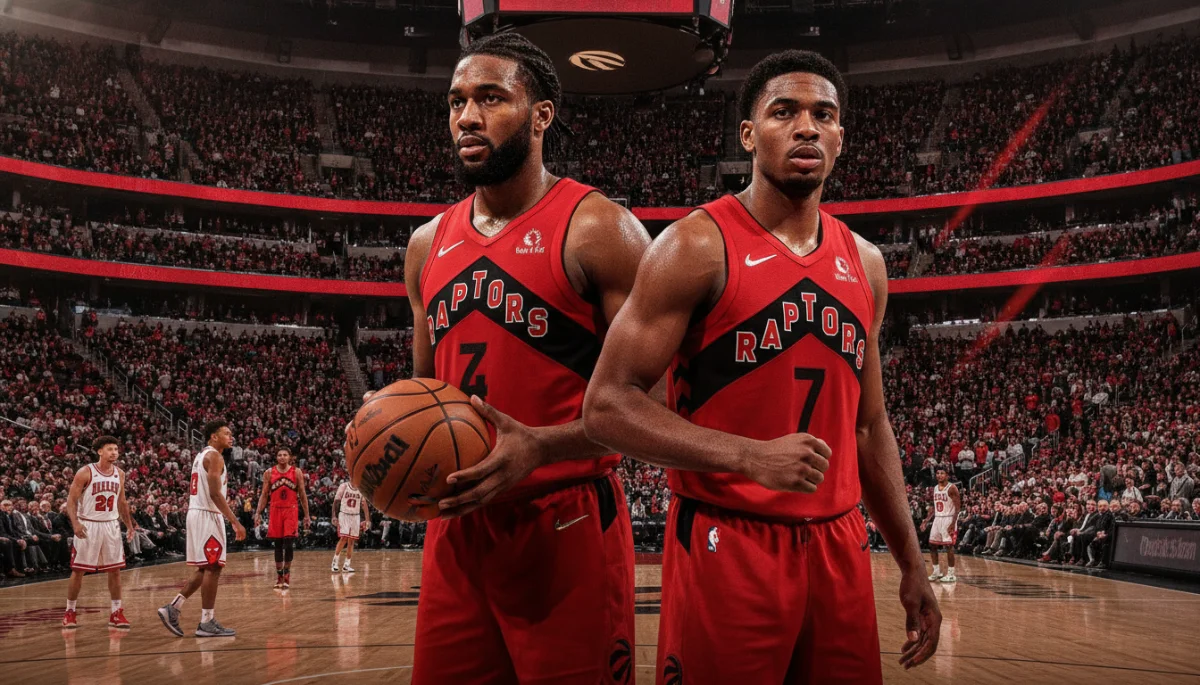
Toronto begins the 2026–27 NBA campaign at home against Chicago on Wednesday, October 21, with tipoff scheduled for 7:30 p.m. ET at Scotiabank Arena. The matchup introduces a Raptors team carrying playoff expectations and a Bulls squad entering the season with a younger, less established core.
The spotlight will naturally fall on Kawhi Leonard, whose return gives Toronto an experienced two-way star. Yet the opening-night result may depend just as heavily on Scottie Barnes, the team’s developing centerpiece, and how quickly the two forwards find a productive rhythm.
Opening-Night Details and Immediate Stakes
Toronto and Chicago are both starting from 0–0, but the teams are approaching the game from different positions. The Raptors are trying to build on a playoff season and move higher in the Eastern Conference, while the Bulls are still searching for a reliable identity after four straight seasons without a postseason appearance.
Home court gives Toronto an additional advantage. The crowd will be eager to see Leonard in a Raptors uniform again, while the coaching staff will use the game to evaluate new rotations, defensive assignments and late-game combinations.
Even so, the first game of a season rarely follows a predictable script. New lineups can produce uneven spacing, missed defensive rotations and turnovers, allowing an underdog to stay competitive longer than expected.
Leonard’s Return Changes Toronto’s Ceiling
Leonard returns to Toronto as one of the most important figures in franchise history. He helped deliver the organization’s first championship in 2019 and became permanently associated with the memorable playoff shot that eliminated Philadelphia.
At 35, his value extends beyond scoring. Leonard can defend powerful wings, read passing lanes and create a reliable midrange option when an offense breaks down. His ability to make difficult possessions manageable could be especially useful in a season opener, when offensive timing may not yet be sharp.
Health and workload management remain central questions. Toronto will need to protect Leonard over the long season without reducing his influence in important games. Against Chicago, his first assignment may reveal whether the Raptors intend to use him primarily as a scorer, a defensive stopper or a central piece in both roles.
His presence also raises the standard for the entire roster. Younger players must learn how to play decisively around a star who attracts defensive attention, while Toronto’s coaching staff must create enough space for Leonard to attack without limiting Barnes’ playmaking responsibilities.
Barnes Gives the Raptors a Second Defensive Engine
Barnes remains the clearest link between Toronto’s present and its future. The versatile forward can initiate offense, rebound from multiple positions and switch onto different types of opponents. His all-around contributions helped him earn a place on the NBA All-Defensive Second Team last season.
He averaged 18.1 points, 7.5 rebounds and 5.9 assists, numbers that illustrate how much responsibility he carries. Barnes does not need to lead the team in shots every night to influence the game; his passing, defensive coverage and work on the glass can shape the outcome just as strongly.
The partnership between Barnes and Leonard is therefore the main tactical storyline. Both players can defend across positions and make plays without holding the ball for long stretches. If they communicate effectively and move the ball quickly, Toronto could create a difficult matchup for Chicago.
RJ Barrett and Immanuel Quickley should also benefit from the attention drawn by the two forwards. Their shooting and downhill attacks will determine whether the Raptors can punish Chicago for sending extra defenders toward Leonard or Barnes.
Chicago’s Young Core Offers a Different Challenge
The Bulls enter the contest with development as a major priority. Josh Giddey, Matas Buzelis and rookie Caleb Wilson are among the players expected to help shape the club’s next phase.
Giddey can pressure defenses with his size and passing, while Buzelis provides length and scoring potential on the wing. Wilson adds another young option whose progress will be watched closely as Chicago searches for dependable combinations.
Chicago must improve its defensive discipline and half-court execution. Against Toronto, careless possessions could quickly become transition chances, particularly if Leonard and Barnes force rushed passes or difficult shots.
The Bulls can still make the game uncomfortable by increasing the tempo. A younger roster may benefit from an open-floor contest, especially if Toronto allows offensive rebounds or loses track of shooters after defensive switches.
Three Matchup Questions to Watch
- Can Toronto create efficient offense late in possessions? Leonard is capable of producing a quality shot when the play breaks down, but the Raptors will need movement from the other four players. Standing around the perimeter would make Chicago’s defensive assignments easier.
- Will Barnes control the rebounding battle? Toronto’s frontcourt must prevent second chances and finish defensive possessions. Barnes and Jakob Poeltl will be especially important when Chicago uses athletic lineups and attacks the offensive glass.
- Can the Raptors defend transition? Chicago’s young players will look for chances to run after missed shots and turnovers. Toronto must balance its desire to attack with enough floor coverage to prevent easy baskets.
Those three areas could determine whether the game becomes a comfortable home win or a competitive fourth-quarter test.
What a Toronto Victory Would Signal
A win would not settle the Raptors’ long-term outlook, but it would provide an encouraging first indication of how the roster fits together. Toronto finished fifth in the Eastern Conference last season and now has additional veteran experience to support Barnes, Barrett and Quickley.
The larger challenge will be consistency. The Raptors must remain healthy, build chemistry and perform against both developing opponents and established contenders. Leonard’s name raises expectations, but the team’s season will ultimately be judged by its habits over many months.
Chicago has enough young talent to expose lapses, particularly if Toronto gives away possessions or fails to control the paint. Still, the Raptors appear better positioned entering the opener because of their home setting, defensive versatility and experience in high-pressure moments.
If Leonard settles into the offense, Barnes attacks decisively and Toronto protects the basketball, the home team should have the edge. The most encouraging outcome would be more than a victory: it would be evidence that Toronto’s new core can play with purpose on both ends of the floor.