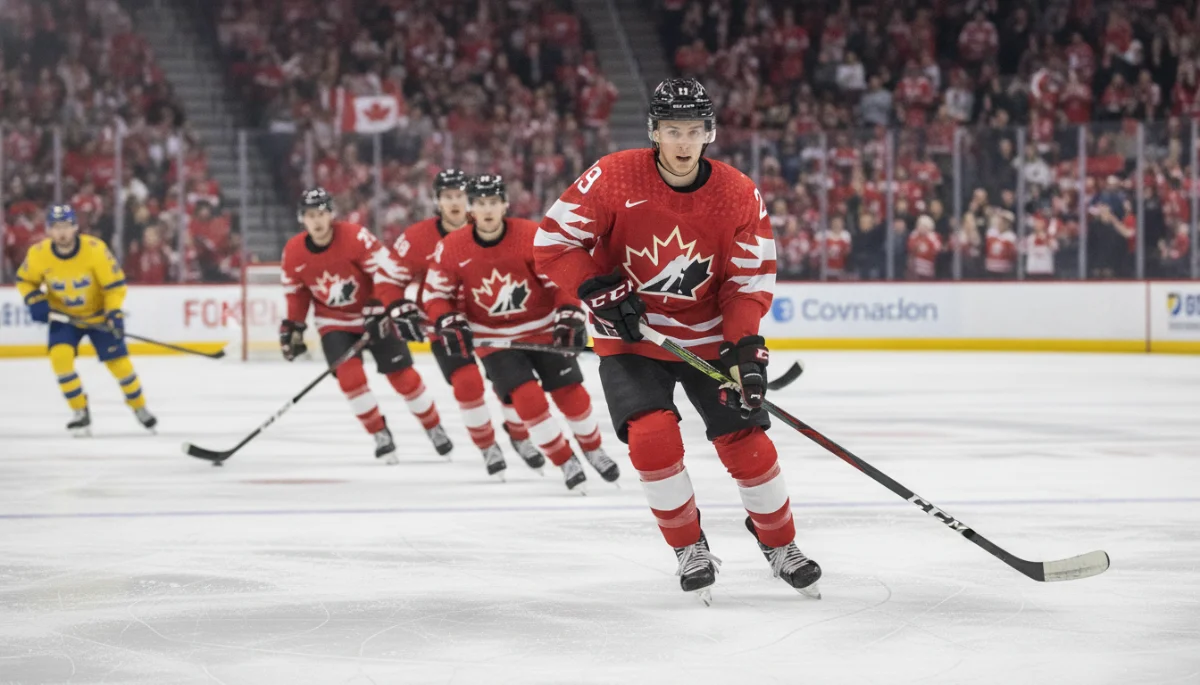
Canada has already locked up a semifinal berth at the 2026 Hlinka Gretzky Cup, but the most demanding hockey is still ahead. After two convincing wins to open group play, the team now shifts from control mode to preparation mode, knowing that the true test begins when the bracket narrows.
The final game of Group A arrives on Wednesday, August 5, against Sweden at Rogers Place in Edmonton. Faceoff is set for 5 p.m. Mountain Time and 7 p.m. Eastern Time, and while the standings give Canada breathing room, the matchup still matters as a tune-up for the knockout stage.
Canada entered the day with six points and first place already secured, which means the result against Sweden will not alter its path into Friday’s semifinals. Even so, the game offers a chance to keep momentum alive, sharpen details, and handle one more opponent with high-end skill before elimination hockey takes over.
A Fast Start Has Put Canada in Command
Canada’s opening performance against Switzerland set the tone immediately. The Canadians won 7-3, scored five times in the opening period, and finished with a 48-25 shot edge that reflected just how often they controlled the puck and forced play toward the Swiss net.
Liam Pue was one of the headliners in that first game with two goals, while Brock England, Camryn Warren, Ryerson Edgar, and Benjamin Veitch also found the back of the net. England added a short-handed goal later in the contest, giving him a memorable two-goal night and underscoring the team’s ability to score in different situations.
The second outing was even more one-sided. Canada rolled past Slovakia 6-1, again dictating pace from the opening shifts and limiting the opposition to very little offense. The Canadians fired 48 shots, while Slovakia managed only 13 attempts, a gap that highlighted Canada’s pressure, structure, and overall depth.
Kayden Stroeder scored twice in the win, and Landon DuPont, Warren, Edgar, and Pue also contributed. In goal, Leif Oaten stopped 12 of 13 shots, giving Canada exactly the type of calm goaltending it needs when the game state allows for a more patient approach.
The early results have also revealed a roster that does not depend on one line to carry the load. Pue, Edgar, and Warren had each reached four points through the first two games, while Maddox Schultz had already collected four assists. That kind of spread matters in short tournaments, where opponents quickly adjust to the most obvious threats.
Canada’s scoring balance has come from forwards, defensemen, and special-teams situations alike, which makes the group harder to defend over multiple games. If one unit cools off in the semifinals, another has already shown it can take over the job.
Sweden Brings Stakes and a Useful Final Test
Sweden enters the matchup with more urgency in the standings. It opened the tournament with a 4-3 win over Slovakia before dropping a wild 7-6 game against Switzerland, leaving its semifinal hopes far less secure than Canada’s.
The Swedes need a strong result against Canada to strengthen their position, which adds competitive tension to a game that Canada can approach with a slightly different mindset. For Canada, this is less about survival and more about tempo, discipline, and getting through one more meaningful test without losing sharpness.
The two teams also met before the tournament began, and Canada won that exhibition 3-1. A preseason result never tells the whole story, but it does give a clue about how the matchup may unfold if Canada brings the same energy and structure it has shown so far in Edmonton.
Sweden has shown it can score. Dorian Eklund Aspe entered the game with four points, and Oliver Sundberg and Milan Sundstrom had each scored twice through two appearances. That offensive balance means Canada cannot coast through shifts or assume the game will stay quiet just because the standings are settled.
For head coach Ryan Oulahen, the meeting can serve several purposes at once. It allows him to examine line combinations, monitor ice time, and prepare his group for the faster, more punishing atmosphere that usually appears once the medal round begins.
Oulahen also carries useful tournament experience. He was part of Canada’s coaching staff when the country won in Edmonton in 2024, and he now leads the program as head coach. That background should help his team stay focused on the larger goal instead of getting distracted by an already-secured place in the semifinals.
The Bracket Still Has One Big Question
Canada’s first-place finish in Group A comes with a clear reward: a semifinal date against the second-place team from Group B. The exact opponent will not be known until the remaining preliminary games are complete, so the last piece of the bracket is still in motion.
Group B remained crowded after two games. The United States sat in first place, with Czechia and Finland level on three points and Germany still looking for its first point. That means Canada’s next opponent could be any of several talented teams, each bringing a different style and challenge.
The tournament format keeps the path simple but unforgiving. The Group A winner meets the Group B runner-up, while the other semifinal pairs the Group B winner with the second-place team from Group A. The two winners move on to Saturday’s gold-medal game, and the losers battle for bronze.
That structure leaves little margin for error. One bad period can flip the entire tournament, and Canada knows that from experience. Last year, the Canadians went through the preliminary round perfectly at the 2025 event before losing 4-3 to the United States in a semifinal shootout. They recovered to beat Finland for bronze, but the semifinal defeat ended their title defense.
That memory gives this year’s team an obvious warning. Strong group-stage play is only useful if it carries over when every mistake becomes more expensive and every scoring chance feels larger.
What This Group Means for Canada’s Bigger Goal
Canada’s history at the summer under-18 event creates expectations that go well beyond simple qualification. Since the tournament began in 1991, Canada has claimed 25 of the 34 gold medals available, including long runs of dominance that set the standard for the entire competition.
The country won seven straight titles from 1996 through 2002 and then added eight more in a row from 2008 through 2015. That track record means the program is measured against championship results, not just competitive performances.
The pressure is even higher when the tournament is held in Alberta. Before 2026, Canada had won gold in every previous Alberta-hosted edition, including Edmonton and Red Deer in 2018, Red Deer in 2022, and Edmonton in 2024. The most recent title came at Rogers Place, where Canada edged Czechia 2-1 in the gold-medal game.
A second straight Alberta title would preserve that perfect provincial record and give Canada its 26th summer under-18 championship. That target is realistic because of the team’s depth, but it remains difficult because the medal round compresses everything into a few high-pressure periods.
It also helps that the Hlinka Gretzky Cup is one of the first major international stages for players entering their draft seasons. The tournament routinely features top under-18 talent from eight strong hockey nations, and its timing allows teams to bring rosters that are closer to full strength than many other events.
For Canadian fans, that makes the semifinal and medal games about more than a possible gold medal. It is also an early look at future NHL names, with DuPont already drawing significant attention and players such as Pue, Edgar, Warren, Schultz, and Stroeder also making strong impressions.
The next step is simple in concept and hard in practice. Canada must turn its early control, offensive balance, and home-ice energy into two more wins. If it does, the team will return to the final with a chance to add another chapter to one of the country’s most successful youth hockey traditions.