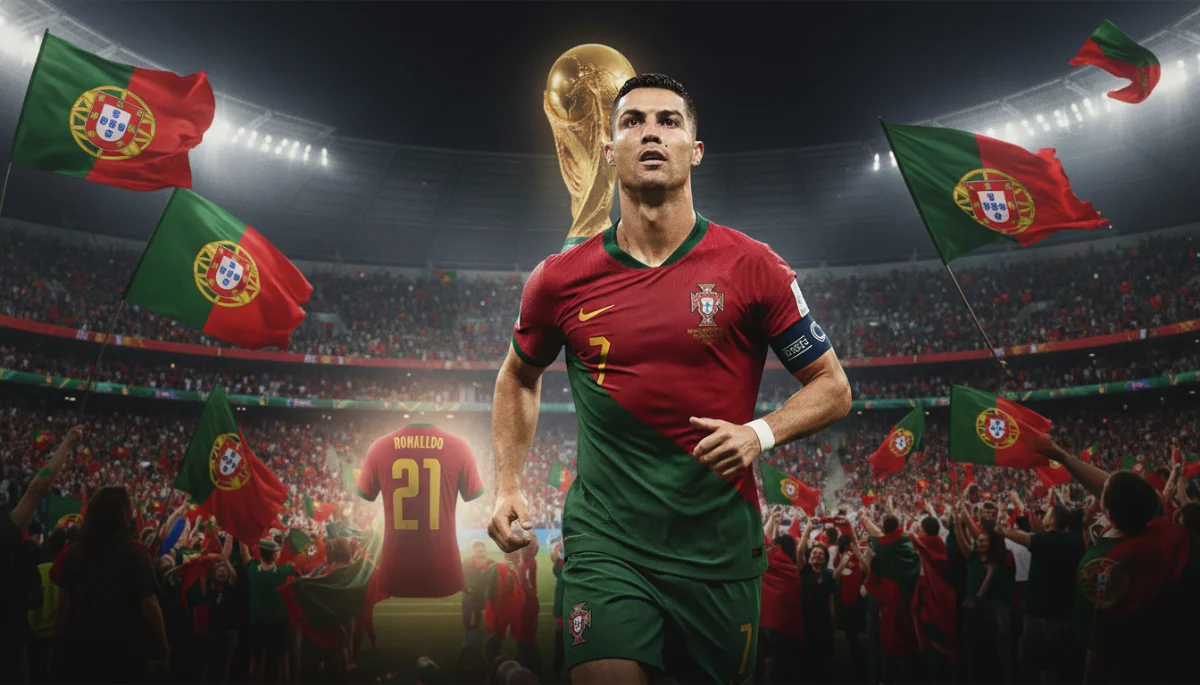
Portugal has unveiled its World Cup squad, and the message is clear: this team is built to compete now. Cristiano Ronaldo is in the group, still chasing one of the few major milestones missing from his legendary career, while Roberto Martínez has also made room for a tribute that gives this campaign an unusually emotional edge.
That tribute centers on Diogo Jota, whose memory will travel with the squad throughout the tournament. Martínez described him as Portugal’s “plus one forever,” turning a routine roster announcement into something far more personal.
Ronaldo’s Shot at a Record-Making Sixth Tournament
Ronaldo remains the defining name in the squad. At 41, he is still central to Portugal’s plans and could become one of the first men to play in six World Cups if he appears at the tournament.
That possibility places him alongside Lionel Messi, who could also reach the same mark for Argentina. For Ronaldo, the stage is familiar, but the stakes are still enormous.
His international résumé already includes several unmatched achievements:
- More goals than any other man in international football
- More appearances than any other man in international football
- The only male player to score in five different World Cups
- A leadership role that still shapes Portugal’s identity
Martínez’s decision is not about nostalgia. Ronaldo continues to matter because of his presence, standards, and ability to handle big moments.
A Squad Built Around Depth, Not Just Star Power
Portugal’s roster is loaded with talent across every line. Martínez has selected a group that mixes experience with energy, giving the team plenty of options depending on the opponent and the match situation.
The goalkeepers are Diogo Costa, José Sá, Rui Silva, and Ricardo Velho. Velho is the emergency option, which makes him the likely spare if injury forces a change.
Portugal’s defensive group brings together strength, pace, and comfort on the ball:
- Rúben Dias
- João Cancelo
- Diogo Dalot
- Nuno Mendes
- Nélson Semedo
- Matheus Nunes
- Gonçalo Inácio
- Renato Veiga
- Tomás Araújo
Rúben Dias is expected to anchor the back line, while Cancelo, Dalot, and Mendes give Portugal real attacking value from wide positions.
In midfield, the balance is even stronger. Bruno Fernandes and Bernardo Silva supply the creativity, while Vitinha, João Neves, Rúben Neves, and Samú Costa add control, recovery, and flexibility.
The attacking group gives Martínez several ways to approach games:
- Cristiano Ronaldo
- Rafael Leão
- João Félix
- Gonçalo Ramos
- Pedro Neto
- Francisco Conceição
- Gonçalo Guedes
- Francisco Trincão
That mix allows Portugal to play through Ronaldo, switch to a more mobile center forward, or attack from the wings with pace and directness.
Jota’s Presence Will Shape the Mood
For all the football discussion, the most powerful part of the announcement was the remembrance of Jota. He died in a car crash in Spain last year at just 28, leaving a deep void in Portuguese football.
Portugal chose to honor him by naming 27 players symbolically, even though tournament squads are limited to 26. The gesture made it clear that Jota will remain part of the team’s story.
Martínez’s message was simple: Jota is not being treated as a memory from the past, but as someone still present in spirit.
That kind of emotional thread can matter in a long tournament. It can tighten a group, sharpen focus, and give every match a deeper purpose.
What Portugal Faces Next
Portugal has been placed in Group K and will meet Congo, Uzbekistan, and Colombia. The opening match comes against Congo on June 17 in Houston.
Before that, the team will begin camp on June 1 and use a short warm-up schedule to get ready:
- Portugal vs. Chile — June 6
- Portugal vs. Nigeria — June 10
- Travel to the United States — June 12
- Portugal vs. Congo — June 17
Those lead-up matches should help Martínez settle on combinations and test the balance between his veterans and his younger options.
Can Portugal Turn Belief Into a Title Run?
Martínez has avoided labeling Portugal a favorite, arguing that the word usually belongs to teams that have already won the World Cup. Still, he believes his squad belongs in the conversation.
That confidence is not baseless. Portugal won the 2025 Nations League by beating Germany in the semifinals and Spain in the final, which showed the team can handle elite opponents under pressure.
The case for a serious run is strong:
- Elite depth in nearly every position
- Ronaldo’s leadership and competitive edge
- Creative midfield play from Bruno Fernandes and Bernardo Silva
- Explosive wing talent such as Rafael Leão and Pedro Neto
- A defense led by Rúben Dias
- Recent proof that the team can win major knockout games
- Extra motivation tied to Jota’s memory
Portugal has never won the World Cup, but this squad has the tools to change that history.
If Ronaldo gets another deep tournament run, he will add one more chapter to a career already full of records. If Portugal converts its talent into cohesion, the nation could finally reach the summit it has long chased. And through it all, Jota’s memory will remain part of the journey.