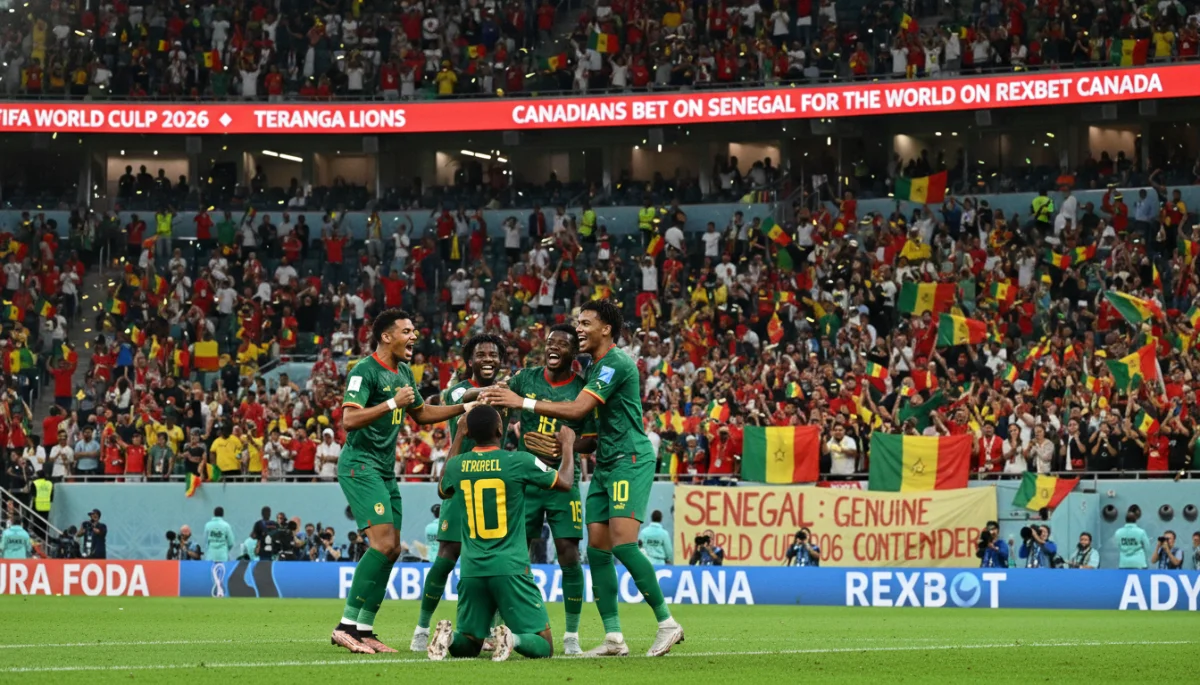
Senegal enters the 2026 FIFA World Cup with real ambition, not just hope. Head coach Pape Thiaw has made that point clearly, and the confidence behind it reflects how far the national team has come in a short time.
What makes Senegal different is not only its talent pool, but the seriousness of its outlook. The team is no longer framed as a surprise story or a sentimental outsider. It is viewed as a genuine contender with a balanced mix of elite veterans, rising prospects, and tactical discipline. That is why the Senegal World Cup 2026 prospects are attracting so much attention, including from bettors who want a credible underdog with upside. Canadians can also bet on Senegal for the World Cup on Rexbet Canada, adding another layer of interest to a team that looks built for a deep run.

Still, the rise of Senegal football has a cost. Beneath the success on the field is a system that produces world-class players while leaving many of the people and institutions that developed them with little financial reward.
A Winning Model Built on Local Development
Senegal has become one of Africa’s most efficient talent producers. For a country of about 20 million people, it consistently develops elite players at a rate that rivals much larger nations. Much of that success comes from academies such as Generation Foot, Diambars, and Dakar Sacre Coeur, which combine coaching, education, and medical support with a direct route into European football.
This system works extremely well for player development. Teenagers are polished quickly, exposed to high standards early, and often move straight into top European clubs. In football terms, the pipeline is impressive. In economic terms, it is far less balanced.
The problem is that the biggest rewards tend to appear far from Senegal. European partners often control the final step in the process, and that means the academy that helped create the player may receive only a small share of the value later generated. One long-running example is FC Metz’s partnership with Generation Foot, a relationship that has helped produce names like Sadio Mane, Ismaila Sarr, and Pape Matar Sarr.
How the money flows
To understand the imbalance, the numbers matter. A recent review of 13 academy-trained players selected for Senegal’s continental squads showed that their local academies received only about €100,000 in initial transfer fees. Those same players were later sold by European clubs for a combined €81.2 million, and their careers have produced more than €411 million in transfer value overall.
That gap explains the frustration. Senegal supplies the talent, but the larger financial gains are captured elsewhere. Local clubs remain underfunded, domestic stadiums often fall short of modern standards, and the national league struggles for visibility.
- The academy system identifies and develops talent early.
- European clubs secure access through long-term partnerships.
- Transfer profits are concentrated outside Senegal.
- Domestic football receives only a fraction of the value created.
The strain is not only structural. Administrative problems have also complicated the picture, with some clubs forced to fight for FIFA solidarity payments that they are already owed. Cases linked to major transfers, including Nicolas Jackson’s move to Chelsea, have highlighted how fragile the system remains when paperwork and enforcement fail.
The Diaspora Edge
Senegal’s rise is not powered by academy graduates alone. The federation has also become highly effective at recruiting dual-national players from the diaspora, especially in Western Europe. Instead of losing those players to France or other major football powers, Senegal now makes a persuasive case early, often before a player becomes permanently tied to another national setup.
That strategy depends on timing and identity. The federation targets players between 16 and 19, then appeals to family roots, cultural memory, and the chance to join a national team that expects to compete. It is a practical approach, and it has already paid off with players such as Ibrahim Mbaye of PSG and Mamadou Sarr of Chelsea, both of whom previously played for France at youth level.
The result is a squad that blends different pathways into one competitive whole. Homegrown talent and diaspora recruits are no longer separate stories. They now form the same project.
Why 2026 Matters
For Senegal, the 2026 tournament is more than another World Cup. It may be the last realistic chance for the country’s celebrated core to make a defining global statement. Sadio Mane, Kalidou Koulibaly, and Edouard Mendy are all at an age where major international cycles begin to narrow.
At the same time, the squad is being refreshed by younger players who bring pace, energy, and technical quality. That balance gives Senegal an unusual profile: experienced enough to handle pressure, young enough to keep evolving, and physical enough to unsettle stronger opponents.
The challenge starts immediately. Senegal’s group includes France, Norway, and Iraq, which means there will be little room for slow starts. The opening match against France in New Jersey may reveal whether Senegal are ready to move from respected contender to true knockout-stage threat.
If they advance, their compact defending, athletic midfield play, and squad depth could make them dangerous in the later rounds. Senegal has the talent to matter in 2026. The deeper question is whether the football machine built to produce that success can ever return enough value to the country that made it possible.