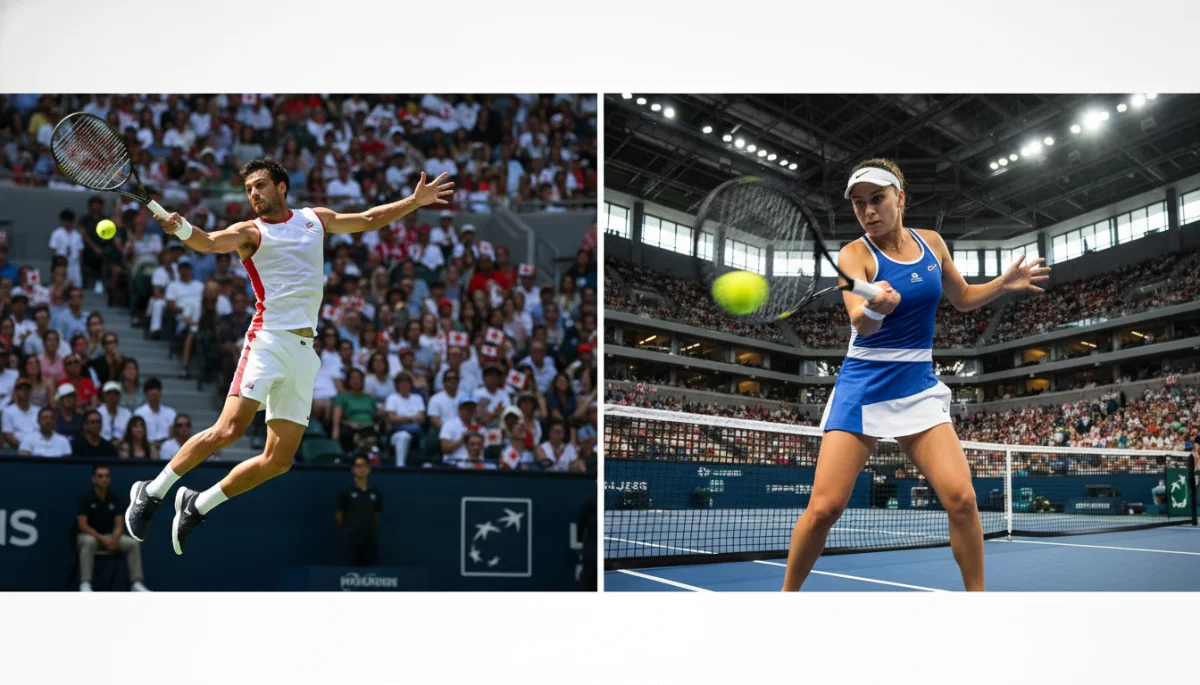
The National Bank Open reaches a pivotal stage this weekend, with the men’s event in Montreal and the women’s event in Toronto both moving into the round of 16. By Sunday night, the field will be cut in half again, and the path to the quarterfinals will be much clearer.
Upsets have already reshaped the men’s draw, while the women’s bracket has largely held to form. That contrast creates a sharp divide between the two cities, with Montreal looking wide open and Toronto still led by several established favorites.
Weekend Match Timing
The round-of-16 schedule is set for Saturday, August 8, and Sunday, August 9, 2026. Montreal and Toronto will each stage four singles matches per day, with the winners advancing to the quarterfinals early next week.
In Montreal, center-court play begins at 12:30 p.m. for day sessions and 6 p.m. at night. Toronto follows a similar pattern, with day sessions also starting at 12:30 p.m. and evening sessions beginning at 7 p.m..
Because match length and weather can affect the order of play, the final schedule is typically released the day before each session. That makes it worth checking for late changes before heading to the stadium or turning on the broadcast.
- Saturday and Sunday will decide the round of 16 in both cities.
- Each venue will host eight singles matches across the two days.
- The winners will move on to the quarterfinals on Monday and Tuesday.
- The official order of play can shift if earlier matches run long.
Montreal Opens the Door for New Contenders
The men’s draw in Montreal has already lost several of its biggest names. Alexander Zverev, Daniil Medvedev, Taylor Fritz, and Andrey Rublev were all beaten early, while second seed Félix Auger-Aliassime withdrew with a back injury before playing his opening match. Six of the top 10 seeds were gone before the second round finished, leaving the event far less predictable than expected.
That chaos has created a major opportunity for the players still standing. Ben Shelton is one of the clearest beneficiaries. The defending champion opened with a straight-sets win over Jenson Brooksby and remains a dangerous presence on the fast courts at IGA Stadium because of his serve and first-strike tennis.
Casper Ruud also looks well positioned to take advantage. The Norwegian handled Juan Manuel Cerúndolo with ease in his first match, and while hard courts are not traditionally his best surface, his experience and consistency give him a real chance in this version of the draw.
Names to Watch on the Men’s Side
João Fonseca may have produced one of the most eye-catching results of the first rounds by knocking out Stefanos Tsitsipas. The young Brazilian already plays with the kind of power that can overwhelm opponents when his timing is sharp, and he appears comfortable with the atmosphere of a big tournament.
Arthur Fils is another player whose game fits the setting. He needed three sets to get past Zachary Svajda, but his athleticism and court coverage make him a serious threat in a draw that has become increasingly open.
Tallon Griekspoor can also no longer be dismissed as a pure surprise story after eliminating Zverev. He recovered from a slow start and showed the kind of composure that can carry over into a deep run when the brackets begin to tilt in his favor.
Canada’s Men Come Up Short
Home support in Montreal was supposed to center on Auger-Aliassime and Gabriel Diallo, but neither man survived long enough to give the crowd a late-stage local story. Auger-Aliassime’s withdrawal removed one of the main title candidates before the tournament really settled in.
Diallo at least gave Canadian fans a promising opening result by beating Kyrian Jacquet for his first main-draw win in Montreal. His run ended quickly, however, when he retired against Luciano Darderi while trailing 6-4, 2-3.
That leaves no Canadian man in the round of 16, even as the crowd still has plenty of compelling players to follow. Shelton, Ruud, Fonseca, Fils, and Griekspoor all bring enough storylines to keep Montreal’s weekend sessions lively.
Toronto Still Belongs to the Top Women
The women’s event has been steadier so far, with the leading contenders mostly moving through the early rounds without major disruption. Aryna Sabalenka, Elena Rybakina, Jessica Pegula, Coco Gauff, and Mirra Andreeva all won their opening matches and remain in the hunt.
Sabalenka continues to look like the player everyone else is chasing. The world No. 1 started with a straight-sets win over Moyuka Uchijima and extended her hard-court winning streak to 13 matches. Her serve and power game are especially effective on Toronto’s quick courts.
Rybakina also remains firmly in the title conversation, even though her second-round match showed both the best and most volatile parts of her game. She had to work through three sets against Daria Kasatkina, finishing with a huge winner count but also a high error total.
- Sabalenka enters the weekend as the top benchmark in Toronto.
- Rybakina has the firepower to challenge anyone when her timing holds.
- Pegula and Gauff bring experience and consistency to the upper half of the draw.
- Andreeva has already shown she can dominate quickly on hard courts.
Pegula, Gauff, and Andreeva Stay Dangerous
Jessica Pegula had to battle harder than expected against Magdalena Frech, dropping the opening set before taking control. Once she found her rhythm, she won eight of the final nine games and reminded everyone why her record in Canada carries so much weight.
Coco Gauff also advanced with authority, though not without some resistance from qualifier Kayla Day. Gauff’s speed and defense kept her in charge of the key moments, which is often enough when rallies become longer and the pressure rises.
Mirra Andreeva may have delivered the cleanest result of the group. Her 6-0, 6-2 win over Karolina Pliskova took only 54 minutes and showed a level of poise that is unusual for a teenager. She is already proving that her clay-court success was not tied to one surface alone.
Leylah Fernandez Carries the Local Hopes
Canada’s best remaining singles hope is Leylah Fernandez, who became the last Canadian left in either draw after defeating Renata Zarazúa. She handled the moment well, winning 6-2, 6-2 and giving the Toronto crowd a reason to stay engaged with the home side of the tournament.
Her next challenge is Elise Mertens, a seasoned opponent who knows how to extend points and force uncomfortable decisions. Fernandez will need to stay aggressive, take the ball early, and keep control of the baseline exchanges if she wants to reach the quarterfinals.
The pressure is obvious, but so is the opportunity. If Fernandez can ride the energy of the crowd and keep her forehand patterns working, she has a real path to another memorable result on Canadian soil.
How Fans Can Follow the Tournament
Sportsnet and TVA Sports are carrying the tournament across Canada, with live coverage from both Montreal and Toronto throughout the week. Their digital platforms also provide streaming access for viewers who want to follow the action away from television.
Since the schedule can shift as matches run long or weather intervenes, fans should confirm the order of play before each session. That is especially important this weekend, when the round of 16 will shape the rest of the event in both cities.
By the end of Sunday, the draw should look very different from the one that opened the tournament. Montreal has already turned chaotic, Toronto still has several marquee players in place, and Fernandez remains the focus for local supporters hoping for one more Canadian breakthrough.