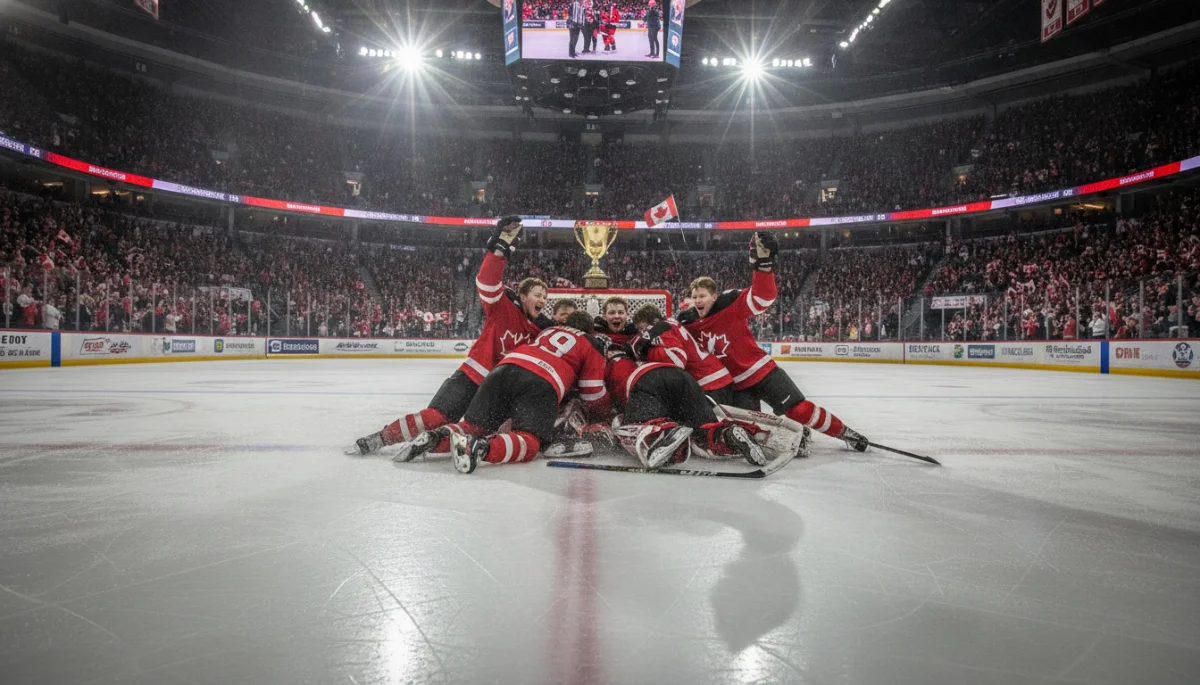
Canada is one win from the 2026 Hlinka Gretzky Cup final after sweeping its preliminary games in Edmonton. The host team now turns to Finland in Friday’s semifinal, with a title chance waiting for the winner.
The Canadian under-18 roster has looked balanced, fast, and difficult to defend. It has produced scoring from several lines, steady play from its defense, and enough depth to make it one of the clear contenders for gold.
Semifinal Details and What Is at Stake
Canada will meet Finland on Friday, August 7, 2026 at Rogers Place in Edmonton. The game will decide whether Canada moves on to the gold medal game or drops into the bronze matchup.
- Mountain Time: 5 p.m.
- Eastern Time: 7 p.m.
- Pacific Time: 4 p.m.
- Atlantic Time: 8 p.m.
- Newfoundland Time: 8:30 p.m.
The championship game is set for Saturday, August 8, also at Rogers Place. The bronze medal game will be played earlier that day at noon Mountain Time, while the final is scheduled for the evening broadcast window.
TSN and RDS are carrying the games from Rogers Place, including the preliminary round, semifinals, and medal games.
How Canada Reached This Point
Canada opened the tournament with a strong 7-3 win over Switzerland, a result that set the tone for its group stage. Liam Pue and Brock England each scored twice in that game, showing that the hosts could generate offense from multiple spots in the lineup.
The Canadians followed with a 6-1 victory over Slovakia. Kayden Stroeder scored twice in that one, and Canada controlled the flow from start to finish to secure first place in Group A.
The final preliminary game was the most convincing in terms of pressure and pace. Canada beat Sweden 7-4 and built a five-goal first period that forced the Swedes to chase the game.
By the end of the preliminary round, Canada had:
- Won all three games
- Scored 20 goals
- Allowed eight goals
That unbeaten record earned Canada a semifinal date with Finland, which finished second in Group B behind the United States.
Who Canada Could Meet in the Final
The other semifinal sends the United States against Slovakia on Friday at noon Mountain Time. The winner of that game will face Canada, if Canada gets past Finland, in Saturday night’s gold medal game.
A Canada-United States final would match the tournament’s two most dominant teams from the preliminary round. The Americans also went 3-0, beating Czechia, Finland, and Germany while allowing only six goals.
The United States would arrive with extra confidence as well, since it enters the bracket as the defending champion after winning the 2025 tournament.
A meeting with Slovakia would create a different kind of test. Canada already handled Slovakia 6-1 in the group stage, but the Slovaks still have dangerous top-end talent. Tomas Selic led all players after the preliminary round with eight points, including five goals and three assists.
Why Finland Is Not a Comfortable Opponent
Finland earned its semifinal place by winning two of its three group games. It opened with a 5-2 comeback win over Germany, then lost 4-1 to the United States before edging Czechia 5-4 in a tense final preliminary game.
Goaltender Samu Heikkinen may be the biggest reason Finland can stay close. He stopped 38 shots against Czechia and entered the semifinals with a .922 save percentage, which ranked among the best tournament numbers after the group stage.
Canada should expect more puck possession and more territorial pressure, but Finland has already shown that it can hang around in tight games. That makes early patience important for the Canadians. If the first wave of offense does not break through, the home team cannot force plays and feed Finnish counterattacks.
Finland also defends in a compact shape, which means Canada may need more than point shots and perimeter cycles. Net-front traffic, second chances, and clean puck movement should matter more than highlight-reel attempts from distance.
Canadian Players Who Can Shape the Result
Maddox Schultz
Schultz has been Canada’s most productive playmaker so far. The Regina Pats forward finished the preliminary round with one goal and six assists, giving him seven points and second place in the tournament scoring race.
His value goes beyond the totals. Schultz has repeatedly found open teammates, created space with smart movement, and made Canada’s attack look more connected.
Liam Pue
Pue leads Canada in goals after the group stage with four. He scored twice against Switzerland and added another goal in the win over Sweden, giving Canada a consistent finisher around the net.
Against a goaltender like Heikkinen, that kind of finishing touch may decide the game. Canada can generate chances, but it needs players who can convert them at key moments.
Kayden Stroeder
Stroeder has been one of the most reliable forwards in the tournament. He scored three goals and added three assists in the preliminary round, including two goals against Slovakia and a strong all-around showing against Sweden.
His speed and versatility make him dangerous in open ice and in transition. He can finish plays, support the puck, and contribute in pressure situations.
Landon DuPont
DuPont has drawn attention as one of the tournament’s premier defense prospects. He recorded one goal and two assists through three games and has already contributed on the power play.
He also brings valuable experience. DuPont was the only player on the Canadian roster who had already won bronze at the 2025 Hlinka Gretzky Cup, and that past success should help in a high-pressure semifinal.
Leif Oaten
Oaten could matter more than usual if Finland makes the game tight. Canada has shown offensive power, but a semifinal can turn quickly if the opponent finds a few clean looks or if special teams become decisive.
If the Canadians keep control of the puck and stay disciplined, Oaten may not face heavy volume. If the game gets scrappy, his ability to make one or two key saves could become central to the outcome.
The Main Edge Canada Brings Into the Game
Canada’s greatest strength is its depth. Several players have already produced offense, which makes the team harder to shut down than a lineup that relies on one star line.
Four Canadians finished among the tournament’s top seven scorers after the preliminary round:
- Maddox Schultz with seven points
- Liam Pue with six points
- Kayden Stroeder with six points
- Ryerson Edgar with five points
The production has not come from forwards alone. DuPont, Jaakko Wycisk, Brock Cripps, and Alexis Joseph have all contributed points from the blue line, which gives Canada another layer of attack.
That spread of offense creates a problem for opponents. Finland may be able to slow one line or neutralize one skill player, but doing that for all 60 minutes is much harder.
What Canada Must Execute to Reach Gold
Discipline will matter first. Canada let Sweden back into the game after building a 5-0 lead, and penalties gave the Swedes a path to momentum, including two power-play goals.
That cannot happen again against Finland. A strong lead loses value quickly when the opponent is handed extra chances.
Canada also needs clean puck management through the neutral zone. Finland is comfortable waiting for mistakes and turning them into quick counterattacks, which means careless turnovers could become expensive.
Finally, Canada needs persistence around the net. Heikkinen has already shown that he can handle a heavy workload, so the Canadians should look for screens, rebounds, and deflections rather than relying only on clean shots from the outside.
Can Canada Finish the Job?
Canada came into the event chasing its record-extending 26th summer under-18 gold medal, and the team has looked capable of making that happen. Its blend of skill, pace, and scoring depth has been strong enough to win every game so far.
The hosts have also benefited from playing in front of a home crowd, which has added energy to an already confident roster. Still, none of that matters unless Canada handles Finland first.
If Canada wins Friday night, it will move one step from the title and one game away from another place at the top of the Hlinka Gretzky Cup standings.